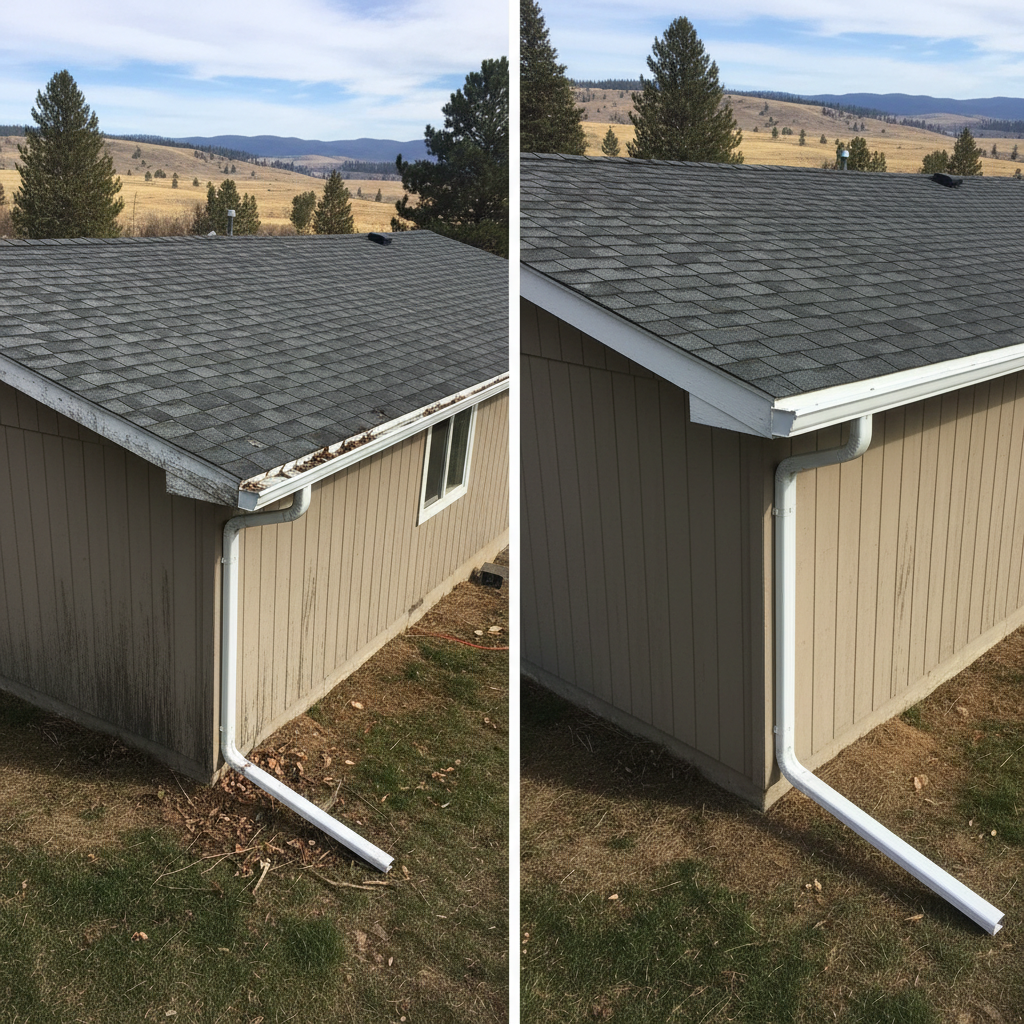
Down here near the Flathead Lake breeze and our heavy winter freeze-thaw cycles, the style of Gutter Service hanging on your fascia matters a whole lot more than most people realize. When you are looking at a full gutter replacement, you face a choice between two main profiles: the standard K-style and the traditional half-round. Valley Gutter wants to break down how they stack up against each other so you can figure out what makes sense for your property in Polson, MT.
Most homes around Polson—whether you are up in the wooded hills or down on the flat lands—sport K-style gutters. They get their name because if you look at the side profile, it resembles a letter K with a flat bottom and a decorative crown molding front. People like them because they move a massive amount of water relative to their footprint. If you get a sudden heavy rain rolling off your roof, K-style handles it without spilling over the front edge. They also fit a modern residential look.
Half-round gutters are a different option entirely. Shaped like a smooth, open cylinder cut down the middle, they have a classic, old-school European charm. You see them on historic properties or custom log-style builds. Because the interior is completely smooth with no sharp corners or crevices, debris does not get trapped as easily in the seams. Water flows right through them during a rainstorm.
Cost and Installation Realities
Standard K-style gutters are the industry workhorse for a reason. They are cheaper to manufacture, easier to fabricate on-site, and most local crews can hang them quickly. That keeps the labor tab reasonable for homeowners.
Half-rounds usually cost more. They require specialized hanging brackets, heavier gauge metals to keep them sturdy, and a bit more craftsmanship during the install to get the slope and alignment looking sharp. If you are on a strict budget, K-style usually wins this round.
Surviving Polson Weather
Our winters here in western Montana are very hard on exterior fixtures. Between heavy snow loads sliding off metal roofs and ice dams forming when the eaves freeze up, your gutters take a beating. K-style gutters are generally stiffer due to their flat back and angled bends, meaning they resist bending under a heavy snowpack well. However, those flat interior corners can collect stubborn ice chunks that take longer to melt out in March.
Half-rounds handle ice expansion a bit differently. Because of their curved shape, expanding ice tends to push upward and outward rather than locking into sharp 90-degree corners. That can reduce the risk of structural splitting when things freeze solid. But you must use heavy-duty hidden hangers spaced closely together, or a heavy Polson snow slide will rip them right off the fascia.
Maintenance and Cleaning
Climbing a ladder to clean out pine needles and cottonwood fluff is nobody's idea of a fun Saturday. K-style gutters trap sludge right in those bottom corners. If you wait too long between cleanings, that wet muck turns heavy and acidic, which can start eating away at aluminum or galvanized steel.
Half-rounds dump debris much easier during a standard flush because nothing gets wedged into a sharp corner. The trade-off is that they overflow a bit quicker if they are not pitched properly because their total volume is sometimes slightly less than a comparable width K-style.
Valley Gutter usually points most homeowners toward a heavy-gauge aluminum K-style system simply because it offers the best performance-to-price ratio for our specific regional climate. But if you have a historic home or just love that architectural half-round look, it is worth the extra investment if installed right. Pick the one that fits your budget and roof pitch, and make sure the work is completed by someone who knows how to handle our mountain weather. For Polson homes and businesses, Valley Gutter provides Gutter Service work.
```